
Holding Soil in Place on Sloped Properties
Muddy Creek Earthwork builds retaining walls for structural support and drainage control in Wexford, Pennsylvania and surrounding areas.
When your property in Wexford, Warrendale, Franklin Park or a surrounding area has a slope that makes it difficult to maintain level areas for parking, landscaping, or building access, a retaining wall holds the soil in place and creates usable space. Without a wall, soil erodes after heavy rain, drainage becomes unpredictable, and the slope continues to shift. A properly built retaining wall resists soil pressure, directs water away from the structure, and lasts for decades without movement or failure.
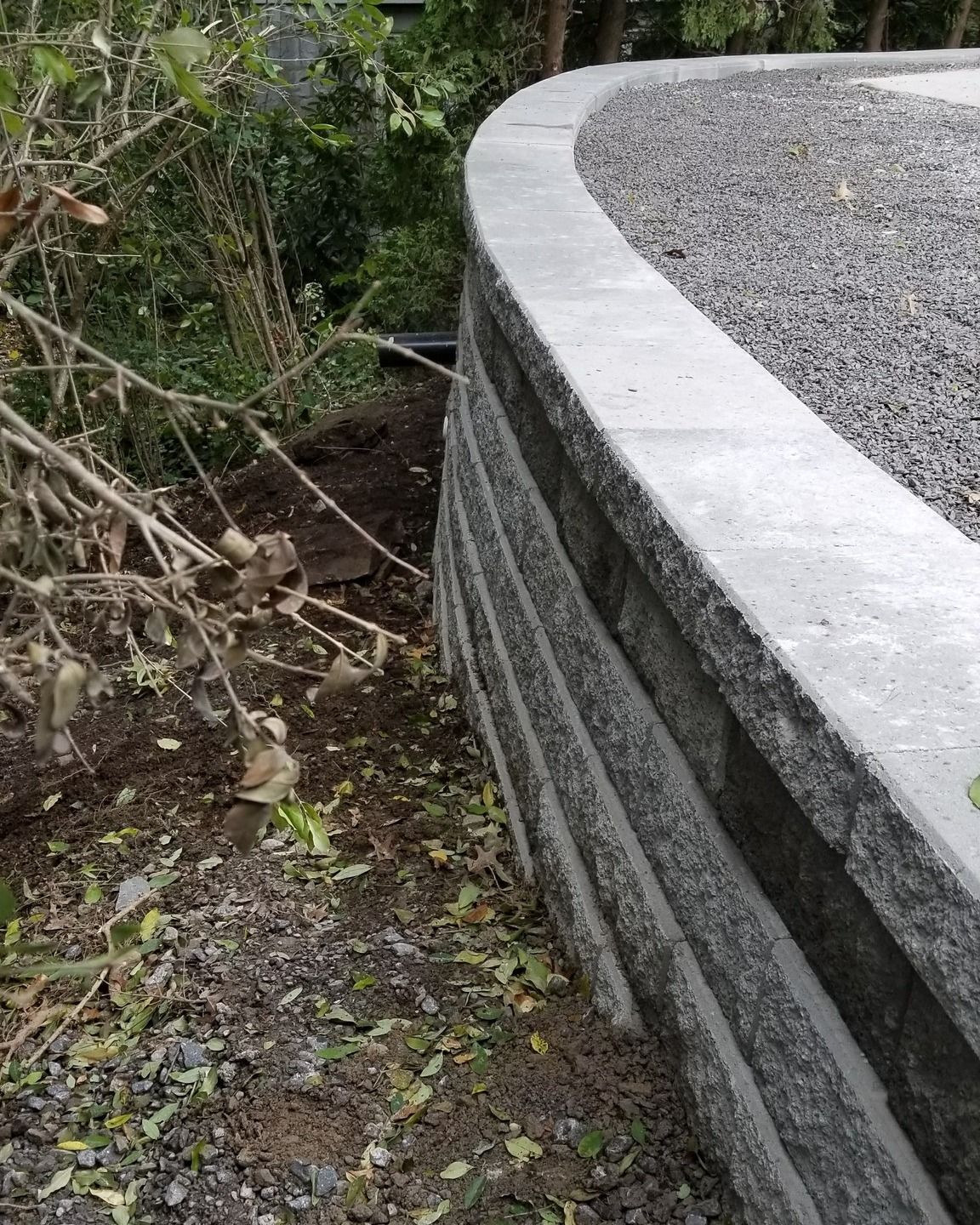
Muddy Creek Earthwork constructs retaining walls for residential and commercial properties throughout Wexford using materials suited to the site conditions and design requirements. The work includes excavation, base preparation, drainage installation, and wall assembly with attention to reinforcement and backfill. Material options include segmental block, poured concrete, and natural stone, chosen based on height, load, and appearance. Walls are designed to manage both vertical load from soil and lateral pressure from water, with weep holes and drainage aggregate placed behind the wall to prevent buildup.
If your property has a slope that needs stabilization or you want to create level areas for future use in Wexford or a neighboring community, Muddy Creek Earthwork can evaluate the site and recommend wall design and placement.
How Walls Are Built to Hold and Drain Soil
Retaining wall construction in Wexford begins with excavation to establish a level base below the frost line. Compacted gravel is placed to provide drainage and support, and the first course of block or stone is set and leveled. Subsequent courses are laid with interlocking or offset joints, and geogrid reinforcement is added when wall height or load requires it. Drainage aggregate is placed behind the wall as it rises, and a perforated pipe collects water and directs it away from the structure.
After the wall is complete, you will notice that the slope no longer erodes, water drains away from the retained area, and the wall remains plumb and stable through freeze-thaw cycles. Level areas created by the wall can be used for landscaping, parking, or building access without concern for shifting soil.
The wall is backfilled in compacted lifts to prevent settling, and the top of the wall is capped or finished to match the surrounding site. Drainage outlets are checked to confirm that water exits below the wall without pooling. Retaining walls do not include landscaping, irrigation, or hardscape features unrelated to soil retention, but they do provide the stable base needed for those elements. Wall design accounts for soil type, slope angle, and water table conditions observed during site evaluation.
Retaining wall construction involves excavation, material selection, and drainage planning, and it is helpful to understand what affects wall performance and how the work is completed.
You might be wondering what to expect
Muddy Creek Earthwork builds retaining walls that control soil movement and manage drainage on sloped properties throughout Wexford, providing stable support that lasts for years. If you want a site evaluation or need to discuss wall design and material options, contact us to schedule a visit.